
FREE CONSULTATION 703-392-6686

What You Should Know About Truck Underride Accidents in Virginia
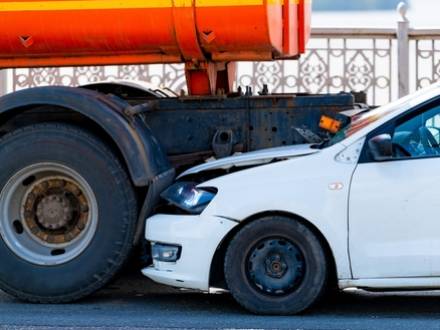 Truck underride accidents happen when a passenger car slides partially or fully beneath a large truck or trailer. Because the truck may strike the vehicle above its main crash-protection structures, the impact can enter the passenger compartment and cause catastrophic injuries. If you or a loved one was hurt in an underride crash in Virginia in 2026, you may have legal options. A Prince William County, VA truck accident attorney can review your case, help identify who may be responsible, and explain what compensation may be available.
What Is a Truck Underride Accident?
An underride accident occurs when a smaller vehicle collides with a truck or trailer. Instead of stopping on impact, the car slides underneath it. Since trucks sit much higher off the ground than passenger cars, this lets a car's safety cage pass beneath the trailer.
Underride accidents most commonly occur when a passenger vehicle strikes the rear or side of a truck or trailer. A related front override accident can occur when the front of a truck passes over part of a smaller vehicle.
In a typical collision, a passenger vehicle’s bumper, frame, airbags, and crumple zones work together to absorb energy and protect the people inside. In an underride crash, the point of impact may be above the bumper and other major crash-protection structures. This can allow part of the truck or trailer to enter the passenger compartment, causing severe head, neck, brain, and spinal injuries.
The National Highway Traffic Safety Administration (NHTSA) has estimated that side underride crashes involving a passenger vehicle and a tractor-trailer cause 89 passenger vehicle occupant deaths each year. The agency noted that underride deaths are often undercounted in federal crash databases.
Does Federal Law Require Trucks to Have Underride Guards?
Federal regulations require many large trailers and semitrailers to have rear underride guards. Virginia State Police inspection rules also require inspectors to check rear impact guards on covered commercial vehicles. NHTSA strengthened its rear-impact protection standards in 2022. Manufacturers generally had to comply with the upgraded requirements for covered new trailers and rear guards beginning July 15, 2024.
In its cost-benefit analysis, NHTSA estimated that requiring side guards on all applicable trailers could prevent about 17 deaths and 69 serious injuries each year. That estimate was based partly on the assumption that the available guard would provide protection only in crashes occurring at no more than 40 mph.
The Insurance Institute for Highway Safety disputed NHTSA’s approach, arguing that it excluded crashes in which side guards might provide protection. Using a different method, IIHS estimated that a mandate could prevent between 159 and 217 passenger vehicle occupant deaths each year. For now, federal law does not require these guards.
Who Can Be Held Liable for a Truck Underride Accident in Virginia?
Several parties can share fault after an underride crash. The truck driver may be liable for making an unsafe lane change, stopping in a travel lane without proper warnings, failing to use required lights or reflective markings, or violating other traffic-safety rules.
A trailer owner or trucking company may be liable for failing to inspect, maintain, or replace a required rear guard. If the guard failed because of a design or manufacturing defect, its manufacturer may also bear responsibility.
Virginia follows a strict contributory negligence rule. If the injured person’s own negligence contributed to the crash, even slightly, they may be barred from recovering compensation. The trucking company and its insurer may argue that the driver followed too closely, was speeding, or failed to react in time. Evidence showing how the crash actually happened is therefore especially important.
Virginia also sets strict deadlines for filing these claims. Under Code of Virginia Section 8.01-243(A), injury victims generally have two years from the date of the injury to file a lawsuit. Under Section 8.01-244, a wrongful death lawsuit generally must be filed within two years of the person's death. Certain circumstances can change these deadlines, and a personal injury lawyer can advise you on your specific case.
What Evidence Do You Need After an Underride Accident?
When possible, the following evidence should be identified and preserved after an underride crash:
-
Photos of the underride guard's condition before it is repaired or replaced
-
Dashcam or nearby traffic camera footage of the crash
-
The police crash report and any citations issued
-
The trailer's ground clearance and guard height measurements
-
The truck company's maintenance and inspection records
-
The driver's hours-of-service logs
-
Electronic data from the truck and passenger vehicle
-
Records showing who owned, leased, operated, loaded, and maintained the truck and trailer
This evidence helps establish whether a missing or defective guard, a maintenance failure, or driver error caused the crash. An attorney can send preservation notices directing the trucking company and other parties to retain the trailer, electronic data, inspection records, and other evidence before it is altered or destroyed.
Contact a Prince William County, VA Truck Accident Attorney for a Free Consultation
The truck accident attorneys at Locklin & Coleman, PLLC work on contingency, so you pay nothing upfront. Attorneys Kevin Locklin and Brian Coleman both practiced insurance defense before representing injury victims, which gives them direct insight into how insurers evaluate claims. We offer home, hospital, and virtual consultations, and every client gets personal attention rather than call-center treatment. Contact a Warrenton, VA truck crash lawyer or call 703-392-6686 to schedule a free consultation.





 |
The Helping Others Heal Scholarship is Now Accepting Applications for the Upcoming College Semester. |

Serious Injuries
Deserve Serious Legal
Representation.
Our attorneys bring decades of experience, careful preparation, and a proven record of results to every case. Contact us today and schedule your free consultation.
FAIRFAX OFFICE
(By Appointment Only)
4041 University Drv., #404
Fairfax, VA 22030
P703-392-6686 Map + Directions
WARRENTON OFFICE
(By Appointment Only)
1 Wall Street
Warrenton, Virginia 20186
P703-392-6686Map + Directions

Contact Us Today

COMPANY
PERSONAL INJURY
CONTACT

Results listed are not a guarantee or indication of future case results.
Manassas Office: 9253 Mosby Str., #100,
Manassas, VA 20110·
703-392-6686


